Wheeler Engineering Tools for Installing and Bore Sighting Scopes

Wheeler Engineering makes several reasonably priced tools to aid in mounting and bore sighting scopes.

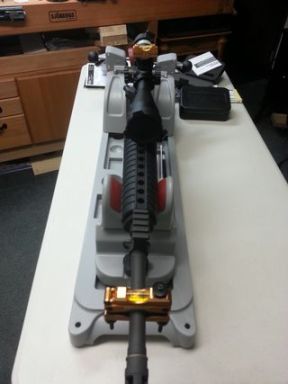
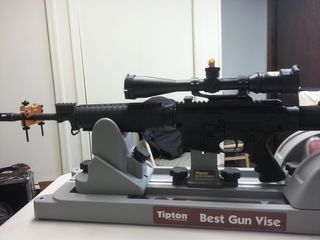
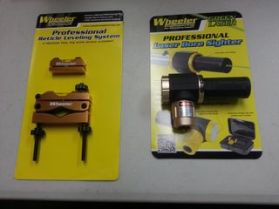
The Wheeler Engineering Professional Reticle Leveling System is a precision tool designed to allow a scope to be leveled on any firearm with relative ease. The system is comprised of two machined aluminum level housings calibrated to their integrated levels. The Barrel Clamp Level is attached to the guns barrel while the smaller Reference Level is placed on scope base, bottom half of a ring or other flat surface perpendicular to the vertical axis of the gun. The gun is rotated until the Reference Level is aligned. The tuning adjustment knob on the Barrel Clamp Level is turned until its level is centered to match the Reference Level. At this point the Barrel Clamp Level is calibrated to the guns axis. The Wheeler Professional Reticle Leveling System is one of the most effective instrument available for precision scope alignment.

The Wheeler Engineering Professional Laser Bore Sight is constructed of a machined aluminum body with soft rubber over-molding which houses the laser module. It's high-power laser is visible during daylight conditions, and a high strength magnetic connection ensures a solid fit to the barrel of nearly all rifles, muzzleloaders, shotguns and handguns. A magnetic connection to the end of a firearm's muzzle provides more precise alignment with the bore while eliminating the risk of damage, which may occur with arbor style bore devices. 

20150518_103455

 The following pictures show the leveling system on Windam Weaponry AR10.

OnRifle_Looking Down

OnRifle_Side View

KJD Firearms Training offers a Mini-Class providing detailed instruction on the use of these tools. Students can bring their firearm(s), scope(s), etc. and install and test with the Bore sight tool. Range time can also be scheduled to verify the install first hand.

Please see our website: http://www.kjd-firearmstrainingllc.com/services/mini-classes


Quick, cheap firearms training is more expensive than you think.

Learning to shoot is not difficult but there's more to it than meets the eye.

Like any other sport, if you develop poor techniques, they are very hard to break. Unlearning always takes much more time than learning to do things right the first time. More time translates to additional correct training and more ammo — obviously ammo is needed to shoot. Ammo, bulk or not, is expensive and getting more expensive each month.

Taking the "short cut", the cheap half-hour session with an RSO (Range Safety Officer) may result in poor shooting techniques.  An important point to remember is that an NRA RSO is NOT necessarily a certified instructor. If they were an instructor, the advertisement will have stated so. As will all things in life, the proof is in the pudding. If you can consistently shoot well after a half-hours session with a non-certified instructor, then you are very fortunate. If your shooting is not consistent, remember that continuing to shoot with poor techniques makes it harder to learn to shoot correctly. 

Unlearning bad habits and poor techniques always takes much more time than learning to do things right the first time.

Rifling, Twist Rates, Velocity and Bullets

The following information is important especially if you are reloading rifle ammunition. However, the brief blog just scratches the surface and additional research and field testing is required.

Rifling is the lands and grooves inside the barrel that provide spin on a bullet as it travels down the bore. This spin stabilizes the bullet in flight similar to a football spiraled by a quarterback. 

A barrel's twist indicates how far the bullet must travel through the bore to make one full revolution. This is the rate of rotation of the rifling. For example, a 9" twist barrel spins the bullet one full turn within 9 inches. In a 16" twist barrel, the bullet makes one revolution in 16 inches. So the 9" twist is faster (spins the bullet faster) than the 16" twist.  Seems obvious but it's worth stating that the 9" twist is less twist than a 16" twist.

The twist in a rifle barrel is designed to stabilize bullets. It takes less twist to stabilize a given bullet at high velocity than at low velocity. At the same velocity (same caliber) longer (pointed) bullets require faster twist rates than shorter (round nose) bullets of the same weight. Heavier bullets require a faster twist than lighter bullets of the same shape. 

In most guns, muzzle velocity is determined by the quality and quantity (burn speed, expansion) of the powder, the mass of the bullet, and the length of the barrel. A slower burning powder needs a longer barrel to burn completely, but can use a heavier bullet. A faster burning powder may accelerate a lighter bullet to higher speeds if the same amount of powder is used. A balance between powder quality and quantity, bullet mass, and barrel length determine optimal performance and safety.

If you are reloading your rifle ammo, you want to know the twist rate of your rifle(s) to ensure the correct bullet weight is used. Most AR-15 rifles have the twist rate printed on the barrel – sometimes up close to the muzzel end. If you can't find it, it's probably identified in the manual and / or the manufacturer can be contacted to find out or verify the twist rate.

There are websites that provide charts that help pull this information together. One such website is Shilen (http://www.shilen.com/calibersAndTwists.html). Listed are general twist guidelines by caliper. For example for .224, a 7 inch twist is good for bullets heavier than 70 grains; a 9 inch twist is good for bullets up to 70 grains.

Berger Bullets has a Twist Rate Stability Calculator at:

 http://www.bergerbullets.com/twist-rate-calculator/ 

This Calculator is specific to Berger Bullets and there are 3 categories possible: Unstable, Marginally Stable and Comfortably stable. There are several paramaters to identify including bullet, temperature, altitude, barrel twist, etc. Once the parameters are entered the stability is displayed.

 Field Test

I tested two AR-15 type rifles with a 9 twist using several different bullets. Bullets used:

  • Hornady V-Max, 50 grain
  • Hornady Varmint, 55 grain 
  • Nosler 77 grain
  • Nosler 68 grain
  • Berger 73 grain

Powder: Hodgdon Varget

Both rifles were most accurate with bullets below 70 grains.


Hornady OverAll Length Gauge – Another key to accurate reloading & shooting

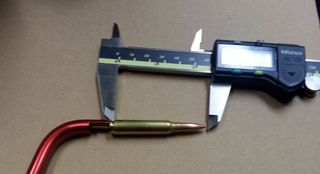
Hornady makes a simple and very useful tool for the rifle ammo reloader looking to improve accuracy. It is call the Hornady OverAll Length (OAL) Gauge. With this tool, it is possible to find out where the rifling in the rifle begins. Using this information, the reloader can seat the bullet to chamber very close to the rifling. A few thousands of an inch change between the bullet and the rifling can go a long way in improving accuracy. Hornady's direction / documentation is very good.

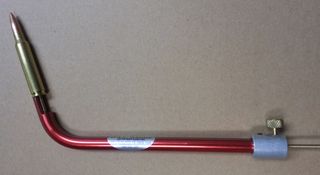
The OAL gauge comes in 2 versions – straight (for bolt action rifles) and curved (for semi-auto rifles). To use the OAL gauge a Modified Case needs to be purchased separately and is sepecific to the caliber of the rifle. The Modified Case is threaded onto the OAL gauge.

Pictured below are the components (curved OAL gauge, Modified Case & a .224 bullet) needed to use the OAL Gauge.  

Hornady_oAL-GAUGE

 This picture shows the components assembled ready for use.

OAL_gauge_with_mod_case_bullet

 Steps:

1. Thread the Modified case onto the OAL gauge and place a bullet into the case mouth. It will and should be loose.

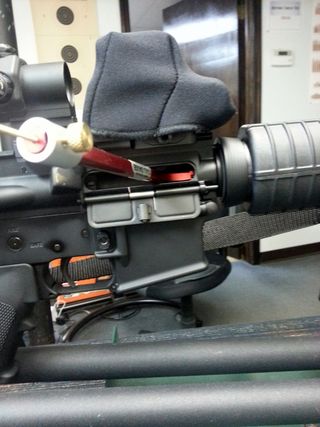
2. With the bolt removed (or held back), place the OAL gauge assembly into the chamber. Be sure the fit is snug.

OAL_gauge_in_chamber

3. Carefully slide the gauge's internal push rod forward until the bullet makes contact with the lands. Tighten the brass thrumbscrew. This will lock the push rod and bullet in place. Remove the unit from the rifle. The bullet may fall out but can be easily inserted back into the gauge as the thumb screw is holding the push rod in place.

4. Position the caliper in the measuring port on the gauge. This port allows the caliper blade to rest on the case head providing relatively easy measurement of the longest possible bullet/case combination that will fit into the rifle chamber. 

No_bullet_comparator

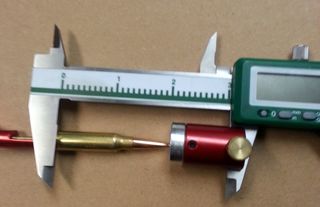
The reason I stated that this provides a "relatively easy measurement" is that measuring across bullets tips is very challenging and not a reliable method for measuring loaded rounds. The reason is simply that there are variations in bullet tips. Hornady has a very good tool to solve the problem. It is called the Hornady Bullet Comparator. It consists of a Body and a Bushing insert that is caliper specific. The Comparator comes with 6 inserts for the most common rifle calipers. The Body (and Insert) are attached to the traveling blade of the caliper. See picture below.

Using bullet comparator

 The Bullet Comparator measures from a reliable surface — the bullet ogive to give consistent and precise measurements of the rounds. Set up is easy. 1. Close the caliper blades snugly on the Bushing Insert and Body. 2. Tighten the Thumb screw and the Set screw. 3. Zero the caliper by setting the dial to "0" to achieve the same starting point in future measurements.

To take a reading, open the caliper blades, center the case head on the caliper's fixed blade and slowly close the caliper so that the bullet nose feeds into the Comparator until contact is made. Be certain all surfaces are aligned and all slack is removed as light pressure is applied to the caliper blades.

Note the reading and take 5 to 10 more readings. There will be some slight variations in the number after each fit. Remember that we're dealing with thousands of an inch. Usually there is two or more identical (or very close) readings and that is the number I usually go with.

For example: Using the Hornaday OAL gauge on my Windam Weaponry, AR-15 with a 73 grain Burger Bullet, I got the following readings: 1.940, 1.932, 1.876, 1.868, 1.872, 1.869, 1.875.  I went with 1.875. Subtracting .040", results in 1.835. After adjusting my Redding Seater die I had bullets seated at 1.812 thru 1.827 — close to 1.835.


In the details directions, Hornaday recommends a free-travel (clearance) of .020" to .040" between the bullet and rifling lands for hunting rounds. They state that free travel over .040" will most often result in a loss of accuracy. However, each gun will have its own preference, and is up to the reloader to determine the optimum bullet free travel by range testing the loads. I decided to range test the bullets before I made any further adjustments in my seating die.

Field Test

Shot 10 rounds at 100 yds with the 73 grain Berger bullets resulted in two bull eyes and the remaining 8 within a three inch circle. I will raise the seating die just a bit to get closer to the ideal 1.835, then test again. 

Shot 10 rounds at 100 yds with the 55 grain Hornady bullets and got slightly better results.

 Both Hornady tools are reasonably priced and readily available from on-line distributors such as MidwayUsa.com and Opticsplanet.com.


Reloading in Limited Space

A common concern for potential reloaders is finding adequate set-up space. Lee has a Reloading Stand that fits in almost any corner. Size: 39" tall x 26" wide x 24" deep.  It is made of sturdy powder coated steel, and places any press at counter stool or standing height. The three-leg design helps to assure stability regardless of the condition of the floor while the rubber tipped legs help to ensure that the stand will not slip on the surface. The steel top can be used with the Lee Bench Plate System. This upper plate comes with pre-drilled holes to fit Lee metallic reloading presses. Presses from other manufacturers can also be used on this stand. The stand includes a steel lower shelf with two bench plate receivers for easy storage of  extra presses or other reloading equipment. On each leg there are eight mounting holes allowing customization with accessories (sold separately). Below is a picture of the assembled stand only.

  Lee_Frame_only

I mounted a Hornaday Lock-N-Load Progressive press on the stand. This press is larger and heavier than most single stange presses and did present a challenge. Below is a picture of the frame press attached to the stand. The L-N-L press is attached to a block of wood (included with the stand) and then the wood is secured to the stand. 

How_LNL_attached to frame

Included with the stand are 2 metal frames that hang from the bottom shelf designed to hold a stone block adding stability to the press. I used a block of wood and place a 25 lb bag of shotgun shot on the wood. Corners of the wooden block can be seen on the bottom of the picture.

Pre-drilled holes on the stand hold additional small storage bins for bullets, shells, etc. The stand comes with one bin and additonal ones can be purchased. 

Inline Fabrication sells an L.E.D. Light Kit with Skylight for the Lock-n-Load press. Obviously very helpful if the stand is set in a poorly lit part of the room. Inline also sells a Double Bullet Tray attached to a swival arm that attaches easily to the back of the Lock-n-Load press. The swival arm can be pushed back when not needed.

Below is a picture of the press with the L.E.D. Light Kit, Double Bullet Tray and a single storage bin installed.

Press_w_lights_&_arm

The Light Kit is easy to install as Inline provides everything needed for proper installation including an alcohol swab to clean areas of the press prior to placement of LED strip and wire holders. The light produced is bright and more than adequate for reloading needs. The Double Bullet tray can be used for shells and/or bullets. The bins are sturdy and hold a good deal of components. There are 100 .45 cal shells in the lower bin on the right in the picture.

YouTube has several videos on the Lee stand as well as attachments available from InLine Fabrication.


Reloading Rifle Ammo – Part 3. Datum Length – Key to accurate reloading.

 This blog is NOT instruction.

 Before beginning any reloading, take a class! This material only highlights areas that may be of interest for those considering reloading rifle ammo and all sections require training, further research and practice. This is NOT a step by step tutorial and do not use it as such. KJD Firearms Training offers reloading classes. Go to: http://www.nrainstructors.org/searchcourse.aspx to find the schedule and prices.


Headspace is critical

For rifle (bottleneck) shells, the term headspace refers to the distance from the breech face (bottom of shell) to the datum diameter of the shoulder . This is called the Datum Length (DL). Since the amount of shoulder bump is under the control of the re-loader, the “DL” dimension can be matched to any chamber by proper adjustment of the sizing die.

Datum Length (DL) specifications are published for every caliber by the Sporting Arms & Ammunition Manufacturer’s Institute (SAAMI) and there is a tolerance of .010” that is allowed. This means that the re-sized shells should be close to SAAMI’s specifications (within .010” of SAAMI’s specifications).

There are tools to help the re-loader adjust the resizing die so that the sized shells are close or at SAMMI specifications ensuring maximum case life and accuracy from reloads. Some of these tools include:

RCBS Precision Mic and Redding’s Instant Indicator.

These tools are sold caliber specific as they include a measuring component that allows the re-loader to get close to SAMMI specifications.

Redding’s Instant Indicator

This unit requires the use of a single stage, stand alone press. Consequently, if you have only one press then the Instant Indicator may be a bit of a challenge to use frequently and it should be used frequently.

There are multiple parts included as well as a set of directions. Although well written, a good video goes a long way to clarify how to use this tool.  Two videos on “Ultimate Reloader” demonstrate two (out of four) functions of the Instant Indicator. Each of these videos are about 10 minutes in duration and well worth the time to watch.

 Sizing: http://ultimatereloader.com/2011/10/16/ar-308-precision-loading-pt-1-case-sizing-and-trimming/

 Bullet Seating: http://ultimatereloader.com/2011/10/27/ar-308-precision-loading-pt-4-seating-bullets-checking-concentricity/


Pictured below are the parts of a Redding Instant Indicator:

  Redding_Instant_Indi


A – Dial Indicator; B – Die Body; C – Adapter & Pressure Spring; D – Set Up Gage;      E – Should contactor; F – Bore Diameter Bushing; G – Blank Contractor

The Instant Indicator consists of a die body with a precision dial mounted on top. The Adapter & pressure spring sit on top of the die body and the Dial Indicator is inserted into the Adapter.

The other internal parts are:

Shoulder contractor is the part that contacts the cartridge case shoulder at the datum point. It is hallow with a black knurled cap threaded into the top.

Blank contractor has a solid blank finish with a precision ground surface at each end. Both ends are identical so insert with either end up.

Set up Gage is a hollow brass gage identified with the cartridge designation. The shoulder angle, datum diameter and datum length (DL) of the gage are made to SAMMI minimum chamber specifications.

Bore Diameter Bushing is a standard Redding neck sizing bushing (selected at bore diameter) that is used to establish the bore diameter contact point when using the indicator to compare bullet seating depth.

Pressure Spring is designed to fit the shoulder contractor cap and either end of the blank contractor. It is used to maintain a uniform contact pressure, insuring consistent readings.

Headspace

To assemble accurate reloads, it is important to understand “headspace” and how it’s related to the firearm’s chamber. Chamber headspace is determined in many different ways, depending on cartridge type (i.e. rimmed, rimless, rebated rim or belted). Most important to the reloader is the measurement from the base of the case to the datum diameter on the shoulder. This dimension is indicated in the following diagram as the Datum Length (DL) dimension:
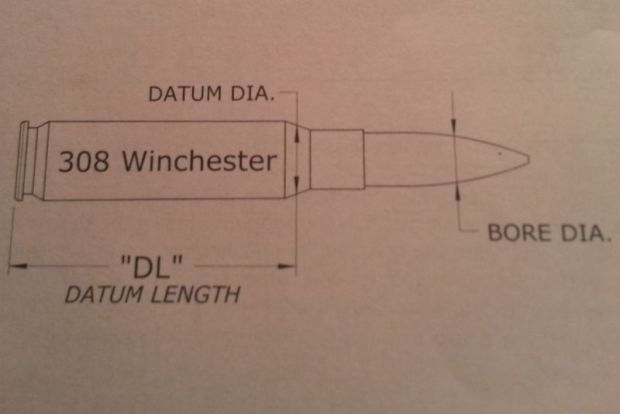
  Datum Length


The amount of shoulder bump is under the direct control of the reloader and so this DL dimension can be matched to any chamber by proper adjustment of the sizing die using the Instant Indicator. This helps ensure extended case life as well as improve accuracy of the reloads.

Using the Set up Gage

To calibrate the Instant Indicator to the minimum chamber specification, slide the Set Up Gage (D) into the shell holder and raise the ram in the press. Loosen the lock screw that retains the dial indicator and raise or lower the dial indicator slightly (it moves very easily) until the needle is near the 12 o’clock position. Tighten the lock screw on the Adapter then rotate the dial indicator face (push back slightly to move) until the zero is aligned with the needle. The Instant Indicator is now calibrated to reference the SAAMI minimum chamber headspace specification.

Start with brass fired from your rifle, 10 or 20 cases and measure each in the Instant Indicator. Do not take an average, the highest reading will most closely indicate the “DL” dimension of your rifle. For example, if the longest reading is .004”, this indicates that the chamber is .004” longer than the minimum and well within the .010” that SAAMI allows for most cartridges.

Sizing the cases

Install the sizing die in the press until it contacts the shell holder when the ram is raised to its uppermost position. Lower the ram and raise (unscrew) the die ¼ to 1/3 of a turn. Size several cases and compare their DL dimension to the previous readings you obtained. If the DL dimension of the cases decreased, raise the die an additional ¼ to 1/3 turn and start with several new fired cases. Most likely, the DL dimension either stayed the same or increased slightly. If so adjust the sizing die down a very slight amount and try again.  Repeat this process until you observe .002-.003” of shoulder bump for cases to be fired in most firearms.  In the previous example, the fired cases that were .004”, would read .001” or .002” after sizing. Cases to be fired in semiautomatic firearms should have their shoulder bumped .004-.006” and the indicator should read .098”, .099” or .000” of the cases started at .004”. When you have the die adjusted properly, tighten the lock ring to keep it set.

Note: It is good to start off with purchased new (or once fired) brass, e.g. Lapua. This will limit fluctuations in DL, something you will experience with brass picked up at a range.

In Part 4, other functions of the Redding Instant Indicator will be covered as well as measuring tools from Hornady.

 

Reloading Rifle Ammo – Part 2

This blog is not instruction.

Before beginning any reloading, take a class! This material only highlights areas that may be of interest for those considering reloading rifle ammo and all sections require training, further research and practice. This is NOT a step by step tutorial and do not use it as such. KJD Firearms Training offers reloading classes. Go to: http://www.nrainstructors.org/searchcourse.aspx to find the schedule and prices.

 Sizing

 Headspace

 For rifle (bottleneck) shells, the term headspace refers to the distance from the breech face (bottom of shell) to the datum diameter of the shoulder . This is called the Datum Length (DL). Since the amount of shoulder bump is under the control of the reloader, the “DL” dimension can be matched to any chamber by proper adjustment of the sizing die. Redding’s Instant Indicator is one tool that facilitates this adjustment ensuring maximum case life and accuracy from handloads.

 Headspace is critical. When setting up a resizing die, the final adjustment should be made using a chamber type headspace gage such as the RCBS Precision Mic or Redding’s Instant Indicator. The regular use of these gages will help to eliminate critical errors. Taking time to use these gages for initial setup and periodic quality control is time well spent. Additional details on the Redding Instant Indicator can be found in a separate post.

 Dies

Note: Before resizing a case apply a lubricant to the case. Imperial Sizing Wax from Redding and Forster’s High Pressure Case Sizing Lubricant are two I found effective.

Two types of sizing dies can be used to size shell cases – Full Length or Neck sizing.

General guidelines are: Full length sizing die is used for reloading when: 1. reloads are used in a semi-auto or lever action. 2. used in more than one rifle. Neck sizing would be used if the rifle is a bolt action and the reloads will be used in the same rifle.

For semi-autos, the case needs to be Full sized – resized to the point that it will enter the chamber freely, completely and with absolutely no hint of resistance. The most common problem is the failure to fully chamber the round. Considering the force with which the bolt slams home, it can wedge the round tightly enough in the chamber that it is very difficult to extract without damaging the rifle.

 With Neck sizing only the neck portion of the case is sized leaving the remainder of the shoulder and body untouched. Chambering a neck sized cartridge normally gives some slight resistance to closing the bolt. This is normal and while a minor problem with the camming forces of a bolt-action, this can be a serious problem with a semi-auto. It can cause a failure to fully seat and chamber the round and so jam the rifle. If the lugs have partially engaged, this is a very difficult stoppage to clear. So don’t Neck size for semi-autos.

Check primer pockets after de-priming. Inspect the web area and the flash hole for any burrs or obstructions. Clean, smooth primer pockets facilitates re-priming.

 Neck Tension

 With Semi-Autos, the abrupt stop the cartridge makes when the shoulder slams to a halt in the chamber, inertia will cause the bullet to slightly move forward. There are two options to counteract this force – applying a crimp or increasing neck tension. There are various crimp dies and the taper crimp fits the bill for my semi-auto rounds. Lee makes a “Factory Crimp” die and I have had some success with this die as well.

The other option is to increase neck tension – get a tighter grip on the bullet. Redding makes a bushing die (Type S Bushing Style Die). A bushing is inserted into the neck of the die. These bushings (usually made of Titanium Nitride) come in .001” increments. To obtain the correct size bushing, measure the neck diameter of several loaded cartridges with a caliper or micrometer. Subtract .001”-.002” from the smallest average neck diameter. This diameter bushing will generally size case necks to create the proper press fit for the bullet. Tension can be increased or decreased by simply changing the bushing size.

Select your dies carefully. As with all reloading equipment, the more research done, the better your selection will be. Various on-line stores such as MidwayUSA.com publish product reviews. Reading these reviews will save both time and money. 

Note: There is reloading equipment for sale in many on-line stores such as E-Bay, Craig's list, etc.  As always, the burden is on the buyer; read carefully and ask questions before purchasing used equipment. That being said, there are some bargains available for the persistent.


Reloading Rifle Ammo – Part 1

This blog is not instruction.

Before beginning any reloading, take a class! This material only highlights areas that may be of interest for those considering reloading rifle ammo and all sections require training, further research and practice. This is NOT a step by step tutorial and do not use it as such. KJD Firearms Training offers reloading classes. Go to: http://www.nrainstructors.org/searchcourse.aspx to find the schedule and prices.

Reloading rifle ammo requires concentration and close attention to many details. Reloading is becoming more and more popular as ammo is hard to find and the prices have risen considerably. Also reloads are usually more accurate than factory ammo due to the fire-formed cases used for reloading as well as other reloading refinements.

Important Note: All reloading equipment manufacturers are very concerned with both your safety as well as your satisfaction with their products. You can call customer service (the number is on their website) with any and all questions or concerns.  There is often a hold time but usually not very long.

Rifle rounds shoot with lots of pressure so the shells elongate and expand due to the high pressure. The shell case does not spring back to the original size. Each case shot is fire-formed to a perfect fit for the rifle's chamber. However, two rifles from the same manufacturer and the same model can have variations in the rifle's chambers. Each rifle is unique and reloads that work in one may not chamber in another.

 Reloading Manuals

Everyone considering reloading needs a reloading manual – actually more than one. A Reloading manual contains information key to reloading – updated load data for various bullet weights including minimum and maximum powder loads as well as minimum overall length (Min. OAL). Almost every bullet manufacturer publishes a reloading manual such as Hornady, Nosler, Sierra, Barnes, etc. Lee doesn’t make bullets but it does make reloading equipment and I found their book – Lee "Modern Reloading 2nd Edition, Revised" a very good reference. The bullet manufacturers naturally favor their bullets. Each manual does have general reloading information in the front (or back). It’s well written and worth the time. As obvious as it may be, it’s important to state: If you use Hornady (Sierra, Barnes, Nosler) bullets, obtain Hornady’s (Sierra, Barnes, Nosler) reloading manual. Key information about their bullets is only found in their manuals.

 Press 

No reloading should be done in a hurry – this is especially true when reloading rifle ammo. At the beginning, I recommend using a single-stage press for reloading rifle ammo. There are many good single-stage presses available. My recommendation is Forster’s Co-Ax Single Stage press. To date, there are 104 reviews of this press on MidwayUSA.com – all of them 5 stars (the best rating).  Of course progressive presses can be used for rifle reloading as well. I prefer not to use them for reloading rifle ammo.

 Bolt action vs. Semi-Auto (AR-15)

 Reloading for gas-operated semi-autos is a bit more demanding and challenging than bolt-action rifles. Differences will be sited throughout this blog.

 Brass Preparation

 Inspect your cases carefully discarding any with dents or tears. Check the case neck area for any signs of cracking. Resizing bottle-neck cases works the neck area somewhat more than the remainder of the case and so this area is the first place to fail or crack. Separate your shell cases by manufacturer and number of times fired. This should be done for all reloading but it’s especially important for shells shot in a Semi-Autos. 

 Brass can be cleaned in a tumbler using a corn or ground walnut shell media. Sonic cleaners are very popular as they get the job done quickly. De-prime the shells prior to putting them in a sonic cleaner as this enables cleaning the inside as well as the outside of the brass. It also cleans the primer pocket and this facilitates re-priming.

 It’s a good policy, at least at the beginning, to purchase quality brass for reloading. As with all quality reloading equipment and components, it is a time-saving investment. Be sure to use a net at the range to catch the brass after firing.


Practice, Practice, Practice — Lenny Magill’s Handgun Workout (DVD)

If you carry a handgun, you need to practice and practice and practice some more. Practice the draw – clearing clothing, getting a good grip on the gun, drawing the gun smoothly, pointing the gun, proper trigger action, reflex response…to mention a few. 

The sub-title of the DVD is "Dry Fire Trainning System". Dry firing often using snap caps and / or laser inserts is key to learning proper techniques.

Lenny demonstrates 5 methods of drawing the gun from concealed carry. He introduces the use of 4 accessories for safe dry fire practice – gun mounted laser pointer, snap caps to practice squeezing the trigger with sights aligned, rubber bullets without powder (only primers) to test shots on paper targets, and a timer to develop a sense of timing reflex response. The end of the DVD provides references for purchasing the items demonstrated. 

I also recommend the Laserlyte Laser Target Training System in conjunction with Laserlyte Cartridge Laser Trainer. The Cartridge is caliber specific and fits into the chamber of your handgun. Very important as this set up let's you practice with the holster and handgun you carry. The Laser Trainer Target gives the shooter visual feedback. To use the Laser Trainer Target simply aim at the target and dry fire the weapon with the LaserLyte Cartridge Laser Trainer. The hits briefly display. To display all impacts, fire the laser at the red display circle on the face of the Laser Trainer Target. To reset the target dry fire the laser at the red reset circle to begin again with a fresh target. This training system can be purchased at MidwayUsa.com.

 The DVD is 75 minutes in duration. Much of the DVD is repetition and this is done intentionally. The message is driven home — Practice over and over if mastery is to be attained. Lenny demonstrates a draw. He could then say "do this fifteen tmes" but he doesn't say it; he does it. Each time adding a reminder concerning one or more key points in the process. It's a great visual aid to use as you practice with him. The "9 Minute Workout" is a real workout and if you do it along with Lenny, you will be tired. One of the best lines is (I paraphase): "Does your arm hurt? Good! it's supposed to!" 

This DVD is an excellent holiday present for your loved one who carries or plans on carrying a handgun.

In The Gravest Extreme by Massad F. Ayoob – Part II

IMPORTANT NOTE: This post does not contain legal advice. It is a summary of the material presented in the book: The Gravest Extreme by Massad Ayoob. For specific legal questions / concerns consult the appropriate legal councel in your state.

Self-Defense & Lethal Force – Chapter 2

Learning gun law can be very challenging. The reality is that once you acquire a firearm, you are obligated to know the gun laws — your state laws as well as the laws of whatever state you are planning on carrying concealed. Books such as Ayoob's provide explanations, keen insights and examples to help clarify legal terms and precedents. 

Some Key Terms:

Lethal Force – Almost any form of physical attack is potentially deadly force. In most cases, lethal or deadly force entails the use of a lethal weapon — gun, knife, budgeon, etc.

Disparity of Force – one of the vaguest concepts in self-defense. It is tied closely to the legal term "Equal Force".  Equal force doctrines require the law-abiding citizen to respond to attack with little or no more force than what is being directed against him/her. Disparity of force is an interpretive concept difficult to break down into hard and fast rules. Shooting a person of similar size attaching you with a knife is more difficult to defend than shooting a person much larger and stronger who attacks you with a knife.

 Reasonableness – The judgement of a reasonable man is a standard pervading our judical system. "It gives the court an avenue whereby extenuating considerations may be pursued beyond the letter of laws conceived by men who had never anticipated certain situations. It permits each case to be judges on its own particular circumstances, rather then being pigeon-holed into one cateofry or another of self-defense law." (p. 10)

When is Lethal force allowed? Only when life and limb are in jeopardy. But what constitutes jeopardy? Does the attacker need to have a lethal weapon? Does a punch or kick warrant armed defense? It is important to realize that the laws were formulated by legislators who spend their lives guarded by armed security in the comfort of their chambers and never witnessed what happens in the streets. Devastating damage to a body can be done with hands and feet. "A seasoned street-fighter, or even an amateur in the grip of a savage, murderous impulse, can puncture your eyeballs, crush your testicles, snap your windpipe, break your spine and cave in your skull in less time than it takes for the scream to choke in your throat." (p. 16)

If you never lived in or were exposed to "rough" neighborhoods, identifying with Ayoob's examples may be difficult. Recently I was reading an opinion in the NY Times titled "Unlearning Gun Violence". (http://nyti.ms/1bwOEYu) The gist of the article is that violence is a learned behavior and it can be unlearned. It identifies "violence interrupters" who try to mediate when something happens that could cause someone in the neighborhood to shoot someone else. It's an interesting concept and perhaps will work in some areas. What was more interesting were some of the comments to the article; I quote one from Maureen O'Brien: "I 'm here to tell you, after 35 years teaching in the inner city, that young guys who want guns will get guns, no matter what and they will use them impulsively to exhibit their power over each other and often over innocent victims from whom they wish to take something. Your humanity, empathy means nothing to them. Killing someone or letting them live (sans money, car, athletic shoes) is left to caprice in the moment. I had kids tell me that they could get a gun in twenty minutes off the street–no biggie. Guns were so common to them. Life and what it means to be a fellow human being mattered very little. What mattered was the show of wealth–possessions, high end labels, living the philosophy of whatever rappers lyrics resonated with their desires, girls willing to be with them despite infidelity and abuse. I can become the distant omniscient narrator here and speak about the lack of a cohesive family run by loving parents and say if only… but we all know this. Truth is this epidemic has been multi-generational so long that it has morphed into "cultural" expressions of who these kids are and when they finally wake up, in a hospital, prison, or court mandated drug treatment centers they are middle aged and responsible for new generations of their own kids replicating the same tragic behavior with the same consequences. I don't see a legislative cure; the answer lies in changing the behavior in each "family" and that is a daunting task." (underline added)

 Bare Fear and Reasonable Fear

The few pages in the book that deal with these two types of fear, I thought, to be very interesting.

Bare Fear is paranoia — you think someone is going to kill you based on words or past threats. Verbal threats are insufficient grounds for lethal force.

Lethal force is ONLY permissible when your life is in jeopardy in the present moment. Cursing you, spitting in your face, even pushing or punching you are not necessarily justifications for lethal force.

Reasonable fear is fear brought on by actions, words or both that put your life in jeapody. If you are reasonably fearful of your life, lethal force may be justified. Notice the words "may be". Ayoob provides examples that clarifiy these two fears. These few pages alone may save you from a prison sentence.

I do hope that these short summaries from a small part of the book interest you, the concealed carrier (or one thinking of becoming a concealed carrier), enough to purchase and study it. I also hope that you are concerned enough after reading and studying the book, to take defensive handguns classes on a regular basis.