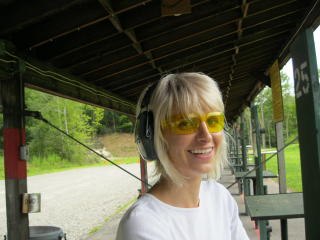
KJD Firearms Training

KJD Firearms Training is focused on personalized firearms training classes.

We train NRA Instructors as well as the shooting disciplines to the public.

Instruction on metalic and shotgun reloading is available. 

We offer the Refuse to be a Victim seminar, the Home Safety Firearm Training and Personal Protection In and Outside the Home. 

Our environment provides safe, in-depth instruction using the NRA firearms classes.

Private instruction is available for specific student needs and we make every effort to accomodate your schedule. 
Grief

Grief

Hurts with a pain beyond all previous

It sears the soul branding a hideous mark.

Heavy waves coming, hitting hard, subsiding… but not for long

A picture, a trinket, a pocketbook and the hurt rushes in yet again

“Don’t resist, accept, welcome” with gut-wrenching breaths I repeat and repeat

Tears flowing, flowing waiting for the peace of non-resistance to take over

And ease my bleeding soul

“It helps you grow, be more compassionate, understanding, loving….”

But the searing pain is now and I want it to go away.

It doesn’t

It’s still there beyond the “comforting words”, the prayers, the pleading…it’s there to endure for as long as it takes and there is no number that’s not too long.

I call upon her to help me…understand it was her choice, her decision

I sort of understand but selfishly suffer…it wasn’t my choice. 

But from there I feel with gratitude my true calling

With closed eyes, I see like I never saw before

With a wounded heart, loving as I never loved before

Going out to heal

Introduce Yourself (Example Post)

This is an example post, originally published as part of Blogging University. Enroll in one of our ten programs, and start your blog right.

You’re going to publish a post today. Don’t worry about how your blog looks. Don’t worry if you haven’t given it a name yet, or you’re feeling overwhelmed. Just click the “New Post” button, and tell us why you’re here.

Why do this?

  • Because it gives new readers context. What are you about? Why should they read your blog?
  • Because it will help you focus you own ideas about your blog and what you’d like to do with it.

The post can be short or long, a personal intro to your life or a bloggy mission statement, a manifesto for the future or a simple outline of your the types of things you hope to publish.

To help you get started, here are a few questions:

  • Why are you blogging publicly, rather than keeping a personal journal?
  • What topics do you think you’ll write about?
  • Who would you love to connect with via your blog?
  • If you blog successfully throughout the next year, what would you hope to have accomplished?

You’re not locked into any of this; one of the wonderful things about blogs is how they constantly evolve as we learn, grow, and interact with one another — but it’s good to know where and why you started, and articulating your goals may just give you a few other post ideas.

Can’t think how to get started? Just write the first thing that pops into your head. Anne Lamott, author of a book on writing we love, says that you need to give yourself permission to write a “crappy first draft”. Anne makes a great point — just start writing, and worry about editing it later.

When you’re ready to publish, give your post three to five tags that describe your blog’s focus — writing, photography, fiction, parenting, food, cars, movies, sports, whatever. These tags will help others who care about your topics find you in the Reader. Make sure one of the tags is “zerotohero,” so other new bloggers can find you, too.

The Benefits of being a Certified NRA Instructor

 There are several benefits, I think, for becoming an NRA Certified Instructor:

  1. Certification brings confidence. I have spoken to many non-NRA instructors who teach others to shoot — family, friends, etc. They have had some success (or so they say) but there's always the realization (which they often voice) that maybe they're not doing something quite right or perhaps there's a better way of teaching a specific skill. 
  2. Better understanding of shooting fundamentals. Reading about the shooting fundamentals — aiming, hold control, breath control, trigger control and follow through — is simple enough. Doing them consistently isn't. Consistent and patient mentoring is necessary to transfer these skills to students. In the process of breaking down the fundamentals and coming up with better or unique ways to communicate them, you become a better shooter. One never really learns a skill until they teach it.
  3. Knowledge and humility. Each student will teach you something. Maybe not something about shooting but maybe something about how to effectively communicate with people and teach more effectively. Each person has unique skills and capabilities and it's enriching to experience them. 
  4. Satisfaction. When you successfully teach someone a new skill (or improve on it), there is a great deal of satisfaction. Perhaps nothing more than a simple "thank you" is said but nothing really need be said. The smile on their face says it all.

My role as an NRA Training Counselor is to teach instructor candidates how to focus on the student and communicate effectively. Being an NRA Certified Instructor is all about helping students. Until you have done this, you have no idea how much you receive in return. 

So what are the pre-requisites for an NRA Certified Instructor? An instructor candidate must be FIRST "a people focused individual" with competent shooting skills — not expert. Your primary motivation must be helping others shoot effectively. 


Alexa_Fun


Why Become an NRA Certified Instructor?

There are several reasons I think, for becoming an NRA Certified Instructor:

  1. Certification brings confidence. I have spoken to many non-NRA instructors who teach others to shoot — family, friends, etc. They have had some success (or so they say) but there's always the realization (which they often voice) that maybe they're not doing something quite right or perhaps there's a better way of teaching a specific skill. 
  2. Better understanding of shooting fundamentals. Reading about the shooting fundamentals — aiming, hold control, breath control, trigger control and follow through — is simple enough. Doing them consistently isn't. Consistent and patient mentoring is necessary to transfer these skills to students. In the process of breaking down the fundamentals and coming up with better or unique ways to communicate them, you become a better shooter. One never really learns a skill until they teach it.
  3. Knowledge and humility. Each student will teach you something. Maybe not something about shooting but maybe something about how to effectively communicate with people and teach more effectively. Each person has unique skills and capabilities and it's enriching to experience them. 
  4. Satisfaction. When you successfully teach someone a new skill (or improve on it), there is a great deal of satisfaction. Perhaps nothing more than a simple "thank you" is said but nothing really need be said. The smile on their face says it all.

My role as an NRA Training Counselor is to teach instructor candidates how to focus on the student and communicate effectively. Being an NRA Certified Instructor is all about helping students. Until you have done this, you have no idea how much you receive in return. 

So what are the pre-requisites for an NRA Certified Instructor? An instructor candidate must be FIRST "a people focused individual" with competent shooting skills — not expert. Your primary motivation must be helping others shoot effectively.


How to obtain an NRA Basic Pistol Certificate

How to obtain an NRA Basic Pistol Certificate

As of May, 15 2016, the NRA Basics of Pistol Shooting course is a blended training course, which means a portion of the course (Phase I) is conducted in an on-line environment which each student completes on their own time. Upon successfully completing the online exams, EACH student will be required to register for the instructor-led training portion (Phase II), which is to be conducted at your local range with an NRA Certified Instructor. You must successfully complete Phase I and Phase II in order to receive your NRA Basics of Pistol Shooting Certificate.  

To register for Phase I go to the following:

https://onlinetraining.nra.org/online-courses/nra-basics-of-pistol-shooting-course/

Once the student passes Phase I they will be able to create a pin number which will allow them to register for Phase II.

To find the schedule of Basic Pistol Phase II classes, go to the following website:

http://www.nrainstructors.org/home.aspx

  1. Click on “Find a Course”
  2. Click on the classes you are interested in – Basic Pistol Phase II
  3. Scroll to the bottom of the screen and key in your zip code. Identify the number of miles you are willing to travel by using the “Mile Radius” drop down; press enter.
  4. My classes are identified by the Sparta, NJ
  5. Select a class and fill in the remaining details.

For Phase II, each student will work with the instructor to obtain hands-on experience for topics covered on-line in Phase 1Basic Pistol Phase II requires the student to Qualify with a handgun to obtain a certificate. This means each student will successfully shoot a specific course of fire:

Minimum Qualification target — 8 inch targets at 8 yards. The student must put 5 shots in each target to qualify.

Note: a picture of the qualification target can be found on my website: http://www.kjd-firearmstrainingllc.com/services

If they own one, the student can bring a handgun and two boxes of ammunition is recommended.  Handguns are available for those who do not own one. Email / call for details.

Once the shooting qualification is successfully completed and appropriately documented, the instructor will print off the NRA certificate for each student.

Basics of Self-Defense & Holsters

Many who travel throughout the US, obtain Out-of-State Concealed Carry permits from states such as Utah, Florida, Virginia, etc. Obtaining these permits is easy and, unfortunately, do not require specific self-defense training.

The mini-class offered by KJD Firearms Training called "Basics of Self-Defense & Holsters" provides an introduction to basic self-defense training using a handgun as well as holster selection and use.

Some of the topics covered are:

1. Developing a person protection plan

  • Be aware and observe your surroundings.

2. Shooting fundamentals for defensive accuracy.

  • Learn concepts and shooting techniques specific to defensive training.

3. Necessary Equipment

  • Selecting the proper holster and practicing drawing form the holster.

4. Range time (optional) 

5. Required reading / viewing

  • "In the Gravest Extreme" (See my posts on a short review of this important book).
  • Handgun Workout (DVD) by Lenny McGill (See my post on a short review of this important DVD)

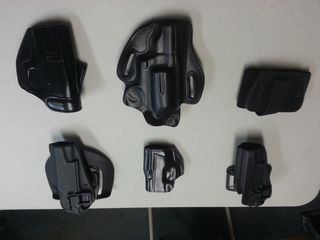
Finding the correct holster for your body and firearm is no small challenge. Most guns stores have holsters in packages and don't usually allow "try ons" — taking it out of the package and trying it on. Being able to try a few without actually purchasing is helpful, allowing one to practice drawing with their own handgun is ideal. Our mini-class does just that.

Why even thing about holsters in a state like New Jersey that doesn't allow concealed carry? Out of state concealed carry permits can be obtained by NJ residents. These permits allow the licensee to carry a concealed handgun in a number of participating states — not, of course, New Jersey. For example, the Utah out of state permit allows a person to legally carry concealed in 32 states. http://www.publicsafety.utah.gov/bci/FAQother.html

Link to details and application: http://www.mylegalheat.com/pdf/CFPapp0511.pdf

KJD Firearms Training conducts a mini-class that provides an introduction to the basics of self-defense and allows the student to try on a number of holsters as well as belts.

Selection_Holsters

Students can bring their handguns or can be provided handguns to practice drawing from the holster. Considerable practice drawing is required before you will know if the holster is a good fit.

Belts are important and some samples are available for demonstration and trying on.

Belts

 This mini-class also identifies and practices exercises to develop and / or sharpen defensive handgun  skills.

Maryland Gun Works (MGW) Sight Pro Universal Sight Installation Tool.

MGW's Sight Pro Tool is a good investment for the serious shooter.

Taking handgun sights on and off can be very challenging and this tool helps in most cases. TruGlo and other manufacturers are making sights that stand out in almost any lighting, enhancing the shooting experience. This tool can help getting the old sights off and the new ones on. The tool comes with a well done DVD providing excellent instructions. The video is also on YouTube.

Assembled_MGW


The tool easily comes apart to facilitate the insertion of the handgun slide.

IN_Half_MGW

To use the tool, a slide shoe (separate purchase – around $20) is needed and these are handgun specific as the fit needs to be tight. The slide shoe below can be used for most Sigs

Slide Shoe_MGW

MGW designed the tool so it can be used as you hold it. The video demonstrates this. I have found it easier to put the tool in a vise. The bottom of the tool has indents for a vice and the handle turns easier when the tool is stable.